
Daikin Altherma C Series
Introduction to the Second Generation Altherma
The Daikin Altherma C-Series represents the second generation of Daikin’s air-to-water heat pump technology and served as the key bridge between the original Altherma (2006) and today’s highly advanced Altherma 3 range. Introduced in the early 2010s, the C-Series brought major improvements in efficiency, usability, and cold-weather performance, making heat pumps far more accessible for typical UK and European homes.
Key advancements of the C-Series included:
Improved seasonal efficiency (SCOP) and higher output at lower outdoor temperatures.
Refined inverter technology for smoother, quieter modulation and better comfort.
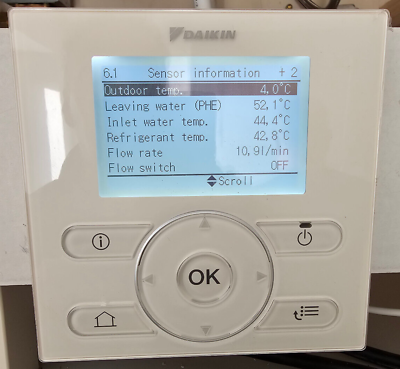
Updated controller designs, offering clearer user interfaces and more precise temperature control.
Enhanced refrigerant circuits and compressors, boosting performance and reliability over the first-generation units.
The C-Series remained on the R410A refrigerant.
Still derived from their air conditioning range the new controller is borrowed from the Sky Air range of air conditioning units but this variation lent itself much better to the heat pump control.
Fault Codes / Error Codes Lookup
The red light flashes and the display indicates a fault code. Search for your code below.
🟢 Low – information or configuration issues. 🟠 Medium – water-side issues or minor faults. Engineer recommended if it persists. 🔴 High – electrical/refrigerant faults. Switch off if in doubt and contact an engineer.
A5 – High-pressure / freeze protection problem (outdoor)
Cause: Outdoor unit detects abnormal pressure or protective operation in cooling / freeze protection.
Action: 🔴 Contact your dealer or installer to check refrigerant side and operating conditions.
E1 – Outdoor PCB defect
Cause: Fault reported by outdoor control PCB.
What you can try: Power the system fully OFF for a few minutes, then ON again.
Action: 🔴 If the error returns, PCB needs diagnosis/replacement by an engineer.
E3, F6, FA – High-pressure switch problems
Cause: High-pressure switch or sensor indicates pressure above safe level in cooling.
Installer checks: Outdoor coil cleanliness, fan operation, correct refrigerant charge, design flow rates.
Action: 🔴 Contact your dealer; do not keep resetting a repeating high-pressure fault.
E5 – Inverter compressor motor overheat
Cause: Compressor motor running too hot.
Action: 🔴 Switch off if unusual noise is present and contact your installer.
E6 – Compressor start-up defect
Cause: Outdoor unit detects a problem during compressor start.
Action: 🔴 Requires professional diagnosis of compressor and drive.
E7 – Outdoor fan motor malfunction
Cause: Fan motor not starting or running correctly.
What you can check:
- Look through the grille for debris, ice or obstructions.
Action: 🔴 If no obvious blockage or error returns, contact your dealer.
E8 – Power input overvoltage (outdoor)
Cause: Supply voltage to the outdoor unit is too high.
Action: 🔴 Contact a qualified electrician / installer to check the power supply.
EA – Cool/heat change-over problem
Cause: Outdoor unit cannot switch correctly between heating and cooling modes.
Action: 🔴 Installer must check the four-way valve and control signals.
H0 – Voltage / current sensor problem
Cause: Fault in sensing mains voltage or current.
Action: 🔴 Electrical safety issue – contact your installer or Daikin service.
H3 – High-pressure switch malfunction
Cause: High-pressure switch circuit itself is faulty.
Action: 🔴 Needs engineer to test and replace switch or wiring.
H6 – Position detection sensor fault
Cause: Position sensor for compressor motor or fan is not working correctly.
Action: 🔴 Contact dealer – internal electronics fault.
H8 – Compressor input (CT) system fault
Cause: Current transformer system monitoring compressor current has a problem.
Action: 🔴 Engineer must inspect compressor drive and CT wiring.
H9 – Outdoor air thermistor fault
Cause: Ambient/outdoor air temperature sensor failure.
Action: 🔴 Contact dealer for sensor testing/replacement.
F3 – Discharge pipe temperature fault
Cause: Problem with compressor discharge temperature or its sensor.
Action: 🔴 Engineer needs to check sensor, charge and operating conditions.
JA, J3, J6 – High-pressure / discharge / heat-exchanger sensor faults
Cause: Faults on high-pressure sensor, discharge pipe thermistor or outdoor heat-exchanger sensor.
Action: 🔴 Contact your dealer; sensors and wiring must be checked.
L3, L4, L5, P4 – Inverter / electronics temperature & overcurrent faults
Cause: Electrical box or inverter heat-sink temperature too high, or DC overcurrent.
Action: 🔴 Turn off the system and contact an engineer to inspect cooling, wiring and PCB.
U0 – Refrigerant shortage (outdoor)
Cause: System detects lack of refrigerant, often due to a leak.
Action: 🔴 Contact an F-Gas-certified engineer; do not attempt to top up yourself.
U2 – Power supply voltage defect (outdoor)
Cause: Mains voltage outside allowed range.
Action: 🔴 Have a qualified electrician/installer check the supply.
U7 – Communication fault between main CPU and inverter CPU
Cause: Internal communication issue inside outdoor electronics.
Action: 🔴 Requires PCB/connection diagnosis by an engineer.
UA – Indoor / outdoor combination problem
Cause: Mismatch or configuration problem between indoor and outdoor units.
Action: 🔴 Power reset may be required; installer must confirm correct model pairing and settings.
7H-01/04/05/06 – Water flow problems
Cause: Insufficient water flow in different operating modes (general, DHW, space heating, cooling/defrost).
What you can check:
- All valves in heating/DHW circuits fully open.
- System pressure at or above the recommended level when cold.
- Air removed from radiators/UFH loops (bleeding).
- Filters/strainers clean if accessible.
Installer notes: Persistent 7H-04/05/06 can indicate circuit issues or possible frost damage to the plate heat exchanger.
Action: 🟠 If 7H errors return after checks, contact your installer.
80, 81 – Return / leaving water temperature sensor problems
Cause: Fault on return or leaving water temperature sensors.
Action: 🔴 Contact your dealer; sensors and wiring need testing.
89-01/02/03 – Heat exchanger frozen
Cause: Plate heat exchanger freezing events detected.
Action: 🔴 Stop the unit and contact your installer – potential frost damage must be checked.
8F, 8H – Outlet water temperature too high
Cause: Abnormally high outlet water temperature, either for DHW (8F) or general heating (8H).
What you can check:
- Confirm temperature setpoints are reasonable.
Action: 🟠 Installer should check backup heaters, control logic and sensors if fault repeats.
A1-00/01 – Zero-cross or EEPROM error (hydro)
Cause: Power detection or memory read problem on hydro PCB.
What you can try: A full power reset.
Action: 🔴 If error returns, PCB needs professional diagnosis/replacement.
AA-01, AC-00 – Backup / booster heater overheated
Cause: Electric backup or booster heater temperature limit exceeded.
What you can do:
- After cooling down, a power reset may clear the fault.
Action: 🟠 If it trips again, installer must check heater wiring, relays and flow through the tank.
AH-00 – Tank disinfection not completed correctly
Cause: Legionella / disinfection cycle did not complete, often due to DHW usage or insufficient pre-heat.
What you can do:
- Schedule disinfection when little or no hot water is drawn for several hours.
- Ensure storage eco or pre-heat is set before the disinfection time if recommended.
Action: 🟢 Adjust scheduling; contact installer if it never completes.
AJ-03 – DHW heat-up time too long
Cause: Tank took longer than expected to reach target temperature.
What you can check:
- Large hot-water draws before the cycle.
- DHW setpoint very high.
Action: 🟢 If heat-up returns to normal, the error clears automatically; persistent issues should be checked by installer.
C0-00/01/02 – Flow sensor / flow switch malfunctions
Cause: Flow sensor or flow switch detects flow when pump is off or behaves unexpectedly.
What you can do: These errors often need manual reset and inspection of the flow measuring devices.
Action: 🟠 Ask your installer to check and clean/replace the flow sensor and switch.
C4-00 – Heat-exchanger temperature sensor problem
Cause: Hydro heat-exchanger sensor fault.
Action: 🔴 Contact your dealer; sensor and wiring need checking.
CJ-02, H1-00, HC-00 – Room / external / tank sensor problems
Cause: Faults on room temperature sensor, outdoor external sensor, or tank sensor.
Action: 🔴 Contact your installer to test and replace sensors as required.
U3-00 – UFH screed dry-out not completed
Cause: Underfloor screed dry-out program didn’t finish properly.
Action: 🟢 Installer should review and rerun the screed dry-out sequence if needed.
U4-00, UA-00/16/22 – Hydro / refrigerant / control-box communication problems
Cause: Communication or matching problem between hydro unit, refrigerant circuit, control box or option box.
What you can try: A full power reset of the system.
Action: 🟠 If errors remain, installer must check wiring, addresses and compatibility.
U5-00, U8-01 – User interface / adapter communication problems
Cause: Loss of communication with the main user interface or optional adapter.
What you can check:
- That the room controller and any add-on adapters are firmly plugged in.
Action: 🟠 Installer should inspect cables and bus connections if problem persists.